TLDR
Gerber is a 4♣ bid over partner’s 1NT or 2NT opening (or a 1NT/2NT rebid) that asks for aces. Partner responds 4♦ (0 or 4), 4♥ (1), 4♠ (2), or 4NT (3). Use Gerber over notrump, where 4NT would be quantitative rather than Blackwood.
In this post, you’ll find the response chart, the king ask, when to use Gerber vs Blackwood, common mistakes, and a practice hand.
Partner opens 1NT and you look down at ♠ A K Q 10 8 5 ♥ K ♦ A K 7 ♣ K 6 4. Twenty points, a six-card spade suit, and slam is in the air. You want to ask for aces before committing, but 4NT over 1NT is not Blackwood. In most systems it is a quantitative invitation to 6NT. If you want aces, you need a different tool.
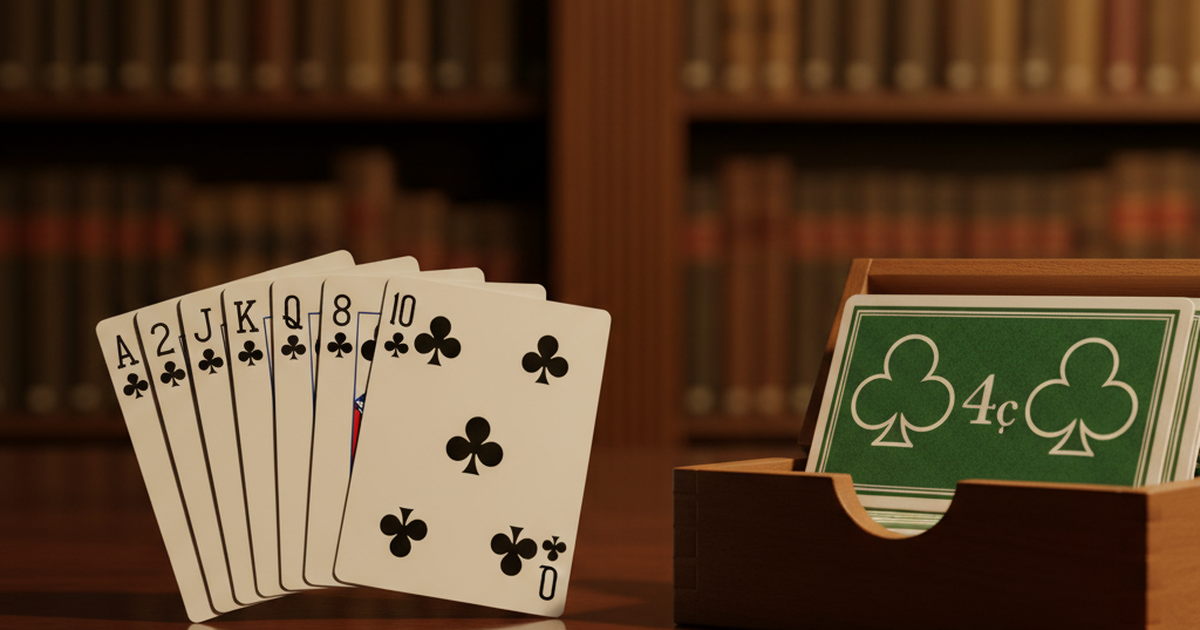
Gerber is that tool. It is the 4♣ bid over a notrump opening or rebid, used specifically when Blackwood is unavailable. The invention dates to the 1930s and it solves one narrow problem: how to ask for aces when 4NT already means something else.
Why the convention exists
Slam auctions over a notrump opening have a problem. The natural 4NT bid is a quantitative invite (showing 16-17 HCP opposite a 1NT, or 11-12 opposite a 2NT). Using 4NT as Blackwood would lose the invitational bid. Most partnerships keep 4NT quantitative and use Gerber for the ace ask.
The 4♣ bid is chosen because it has no natural meaning in these auctions. Partner could never hold clubs as a suit to play in at the four-level after opening notrump, so 4♣ is free for conventional use. It also saves space compared to 4NT, letting responder sign off at 4NT after the ace response.
The basic mechanics
Gerber is 4♣ over partner’s 1NT or 2NT opening, or over a 1NT/2NT rebid by partner. Partner responds in steps showing ace count.
| Partner’s response | Aces |
|---|---|
| 4♦ | 0 or 4 |
| 4♥ | 1 |
| 4♠ | 2 |
| 4NT | 3 |
Asking for kings
After partner shows aces, a rebid of 5♣ asks for kings using the same step structure.
| Partner’s response | Kings |
|---|---|
| 5♦ | 0 or 4 |
| 5♥ | 1 |
| 5♠ | 2 |
| 5NT | 3 |
The 5♣ king ask is only valid when the partnership already confirmed all four aces. If an ace is missing, the partnership should have signed off in 4NT. Calling for kings without all the aces is a misuse.
When to use Gerber vs Blackwood
The rule is simple. Gerber is for notrump openings and rebids. Blackwood is for everything else.
| Auction | Use |
|---|---|
| 1NT – 4♣ | Gerber |
| 2NT – 4♣ | Gerber |
| 1♥ – 1♠ – 1NT – 4♣ | Gerber |
| 1♠ – 3♠ – 4NT | Blackwood (trump suit agreed) |
| 1♥ – 1♠ – 2♦ – 4NT | Blackwood (trump suit ambiguous) |
The principle: Gerber is only Gerber after partner has opened or rebid notrump. In auctions without a notrump opening, 4♣ is natural and 4NT handles the ace ask.
Gerber vs Roman Keycard
Gerber asks for aces only. It does not count the king of trumps as a keycard (there is no trump suit in most Gerber auctions). Gerber is therefore equivalent to regular Blackwood, not Roman Keycard Blackwood.
Some partnerships play Gerber as Key Card Gerber where the king of responder’s long suit counts as a fifth keycard, but this is advanced and unusual. For most club play, stick to plain ace-asking Gerber and let Blackwood handle the suit-contract keycard detail.
Common mistakes
1. Using 4NT after 1NT thinking it is Blackwood
This is the most common confusion at the club. Over partner’s 1NT opening, 4NT is a quantitative invitation to 6NT, not Blackwood. Partner will pass with a minimum and bid 6NT with a maximum. If you bid 4NT with slam interest in a suit contract, you end up in a mismatched auction. Use 4♣ (Gerber) to ask for aces.
2. Gerber with a club suit
If your slam try is based on a long club suit, a 4♣ bid is ambiguous: is it Gerber or natural? Partnership agreement resolves this. Most pairs play 4♣ as always Gerber over a notrump opening, so a natural club slam try has to be routed through a transfer or a jump shift instead. Do not freelance a natural meaning without discussion.
3. Asking with no interest in the answer
Gerber should only be used when the partnership might be in a 6-level or 7-level contract, and the ace count decides. If you have 33+ HCP opposite a 1NT opener (14 opposite 15-17), you already know the partnership has all the aces on a point-count basis, so Gerber is unnecessary. Just bid 6NT directly.
4. Asking for kings when an ace is missing
5♣ over a Gerber response that showed 2 aces (and you have 1) asks for kings. But if the partnership has only 3 aces, slam may not make even with all the kings. Sign off at 4NT when the aces are insufficient, or proceed to 5NT if you are willing to play slam with four aces guaranteed. 5♣ should only follow a confirmed 4-ace total.
5. Using Gerber in the wrong auction
Gerber applies only immediately after a notrump bid. In auction 1♥ – 2NT, the 4♣ bid is a splinter (showing short clubs with slam interest) rather than Gerber, because the notrump was responder’s not opener’s. Partnerships need an explicit rule for whose notrump triggers Gerber, usually “opener’s notrump opening or rebid only.”
A practice hand walked through
Partner opens 1NT. You look down at:
You hold:

  ♠ A K Q J 9 4
  ♥ A K 3
  ♦ K Q 5
  ♣ 7

Auction so far:  Partner   You
                 1NT       ?
Twenty-one high-card points and a strong six-card spade suit. The partnership has at least 36 HCP combined and a likely eight-card spade fit. Grand slam is within reach if partner has the right aces.
You bid 2♥ (Jacoby Transfer to spades). Partner completes with 2♠. You now jump to 4♣, Gerber. Partner’s response decides the slam level.
- Partner bids 4♦ (0 aces): must be 0 from the point range. Sign off at 4♠. Grand slam is out, you are missing the ♣A.
- Partner bids 4♥ (1 ace): bid 6♠. You have the other three aces, partner has one. Small slam is cold.
- Partner bids 4♠ (2 aces): bid 5♣ asking for kings. With two aces plus yours, all four are present. Now you decide on seven based on kings.
- Partner bids 4NT (3 aces): impossible from point range. Reconsider whether you counted correctly.
Notice the Jacoby Transfer first. That establishes spades as the trump suit so partner knows which side has the long suit. The 4♣ bid after 2♠ is then unambiguously Gerber, because partner’s 2♠ was just a transfer accept, not a natural notrump. If you had gone direct 4♣ over 1NT, partner would have known it was Gerber, but the transfer sequence gives extra information about shape first.
Putting this on your card
Agree with your partner on three points. First, exactly when is 4♣ Gerber (most pairs say “over opener’s notrump opening or rebid only”). Second, whether 5♣ after the Gerber response is always the king ask or sometimes a sign-off. Third, whether you play Key Card Gerber at all (usually: no, stick to plain ace-count Gerber).
With those three agreements, Gerber becomes a simple tool you use perhaps once every 20 sessions. It earns its place on the card because the auctions where it applies are uniquely hard to handle without it.
Frequently asked questions
When should I use Gerber instead of Blackwood?
Use Gerber over a notrump opening or rebid, where 4NT is quantitative rather than Blackwood. Use Blackwood in suit auctions where a trump suit is agreed. The rule of thumb: if 4NT in the auction means “invite to 6NT,” then 4♣ means “ask for aces.” If 4NT means “ask for aces,” skip Gerber entirely.
What does partner bid with 0 aces in Gerber?
4♦, which also shows 4 aces. The ambiguity is almost always resolved by the asker’s point count. Opener with a 15-17 HCP 1NT rarely holds 0 aces or 4 aces, making the range-based reading unambiguous in practice.
Can I ask for kings after Gerber?
Yes, 5♣ is the king ask after a Gerber response, using the same step structure as the ace ask. Only ask for kings when all four aces are confirmed, because a grand slam still requires the aces anyway.
Is Gerber ever natural?
In most modern partnerships, 4♣ over a notrump opening is always Gerber. Natural slam tries in clubs go through different routes, such as a transfer to clubs or a strong club raise. If you need to show a natural club suit, discuss an alternative route with your partner before sitting down.
Does Gerber count the king of trumps as a keycard?
Standard Gerber asks for aces only. Some partnerships play Key Card Gerber where a specific suit’s king counts as a fifth keycard, but this is uncommon and adds complexity. For club play, stick to the simple four-ace count and leave Key Card treatment for Blackwood.
Can I use Gerber after a 2♣ strong opening?
Usually no. Over a strong 2♣ opening, the auction is already game-forcing and has different slam-try structures. Gerber is typically reserved for notrump openings (1NT, 2NT) and notrump rebids. Partnerships that extend Gerber to other auctions should spell that out explicitly.