TLDR
Lebensohl is a set of agreements used after partner opens 1NT and the opponents overcall. A 2NT bid by responder is artificial, asking partner to bid 3♣. Direct three-level bids are natural and game-forcing. A cue-bid of the overcaller’s suit is Stayman. The bid (or avoidance) of 3NT shows or denies a stopper in the overcalled suit, depending on partnership style.
In this post, you’ll find the full structure, the “Fast Shows, Slow Denies” rule and its variants, the cue-bid Stayman mechanic, common mistakes, and two practice hands.
Partner opens 1NT, your right-hand opponent overcalls 2♠, and it is your turn. You hold ♠ 4 ♥ K 10 8 7 5 ♦ A J 6 3 ♣ Q 8 2. You have the values for game. You want to find a heart fit. You also want to know whether partner has a spade stopper so you can play 3NT safely. There is a lot to communicate and only one bid to start the conversation. Without Lebensohl, you are guessing.
Lebensohl is the framework that makes this auction manageable. It separates weak sign-offs from invitational and game-forcing bids, and it lets the partnership ask about a stopper when one is needed and deny one when you are hoping partner has it. The convention was named after George Boehm’s old partner Ken Lebensold, and it has become the standard tool for intermediate pairs dealing with interference over 1NT.
Why the convention exists
Without Lebensohl, the auction 1NT (2♠) has too few bids and too many meanings. A natural 3♥ could be weak (trying to sign off) or game-forcing (trying to find a fit). 3NT could be bid with or without a spade stopper. The two-level is gone. The partnership needs a way to signal weak versus strong, and to handle the stopper question.
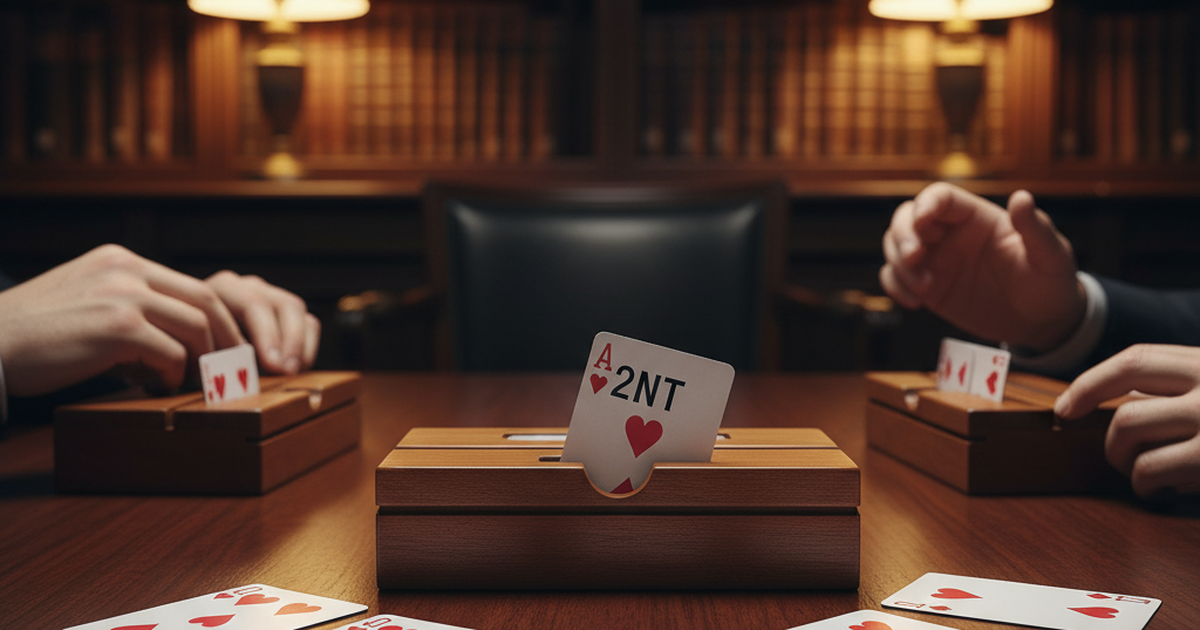
Lebensohl creates that structure by hijacking 2NT as a relay. Instead of showing a balanced invitational hand (the natural 2NT meaning), 2NT now asks partner to bid 3♣, after which responder can clarify. Weak hands pass or correct to their suit at the three-level. Strong hands jump directly to three-level bids without going through 2NT. The partnership knows which is which from the first call.
The basic structure
After 1NT – (overcall) – ? (where the overcall is at the two-level in a specific suit), responder’s bids break down as follows.
| Responder’s bid | Meaning |
|---|---|
| Pass | No action. Partner may reopen with a double. |
| Double | Penalty (classic) or negative (modern) |
| 2 of a new suit (at 2-level) | Natural, competitive, non-forcing |
| 2NT | Lebensohl, forces 3♣ |
| 3 of a new suit (direct) | Natural, game-forcing |
| Cue-bid of overcaller’s suit (direct) | Stayman, game values, stopper handling depends on style |
| 3NT (direct) | Natural, shows (or denies) a stopper depending on style |
After 2NT forces 3♣, responder continues:
| Sequence | Meaning |
|---|---|
| 1NT-(2♠)-2NT-3♣-Pass | Weak, clubs |
| 1NT-(2♠)-2NT-3♣-3♦/3♥ | Weak, sign-off in the suit |
| 1NT-(2♠)-2NT-3♣-3♠ (cue) | Stayman, reverse stopper style |
| 1NT-(2♠)-2NT-3♣-3NT | Game values, reverse stopper style |
Fast Shows, Slow Denies: the stopper rule
This is where most partnerships either agree or get burned. The rule, in its most common form:
- Fast (direct) 3NT: shows a stopper in the overcaller’s suit.
- Slow (through 2NT) 3NT: denies a stopper, asking partner to bid 3NT with one.
- Fast cue-bid: Stayman, denies a stopper (asking partner for one).
- Slow cue-bid: Stayman, shows a stopper.
The mnemonic is “Fast Shows, Slow Denies” for notrump, and “Fast Denies, Slow Shows” for the cue-bid Stayman. The two rules are deliberately inverted, which is one reason the convention takes practice.
Some partnerships reverse the notrump rule and play Slow Shows, Fast Denies. Neither is objectively better. Pick one and write it on your card. Mixed agreements cost games.
The Stayman cue-bid
Because the natural 2♣ Stayman bid is no longer available after an overcall, Lebensohl replaces it with a cue-bid of the overcaller’s suit at the three-level. A direct cue-bid is Stayman without a stopper. A cue-bid after 2NT is Stayman with a stopper. (Or reversed, per partnership agreement.)
After the Stayman cue-bid, opener responds as normal: the unbid four-card major first, or 3NT with no major, or the cheapest notrump bid to deny or confirm the stopper. The partnership can then raise to four of the major with a fit, or play 3NT if a stopper is confirmed.
Over a takeout or penalty double
Lebensohl applies after a suit overcall, not over a double of 1NT. Over a double, partnerships play either systems on (Stayman and transfers still apply) or a runout system (pass, redouble, or two-of-a-suit to escape). Do not apply Lebensohl in this situation. The 2NT bid after a double is typically artificial in runout structures (usually showing a specific hand type like one minor), not a relay to 3♣.
Over a conventional overcall
If the overcall shows two suits (Cappelletti, DONT, Landy), Lebensohl gets trickier because there is no single suit to cue-bid and no single suit requiring a stopper. Most partnerships simplify: treat the overcall’s anchor suit (or the suits shown) as the “overcall suit” for Lebensohl purposes. This is an advanced agreement and worth leaving out until your base Lebensohl is solid.
Common mistakes
1. Using 2NT naturally after an overcall
Old-school players with balanced 8-9 HCP reach for 2NT as an invitational bid. With Lebensohl in play, 2NT is a puppet to 3♣ and invitational hands go through different channels. Pass with the invitational balanced hand (too risky after an overcall anyway) or double for penalty if you trust partner’s notrump opening.
2. Getting the Fast/Slow rule backwards
The cue-bid rule is inverted from the notrump rule. Fast 3NT shows stopper. Fast cue-bid denies stopper. If you forget which is which, you will ask for a stopper partner doesn’t have or bypass a sure 3NT with a stopper in hand. The fix: drill both rules until they are automatic. Most players find it easier to remember Fast Shows Stopper in notrump and then invert for the cue-bid.
3. Going through 2NT with a weak hand that has no sign-off suit
2NT forces 3♣. If you bid 2NT planning to pass 3♣ but partner has shaped a strong opening that wants to super-bid, the auction can get uncomfortable. Use 2NT only when you have a real club or diamond suit to sign off in, or when you have real game interest and want to deny a stopper.
4. Cue-bidding without game values
A cue-bid of the opponent’s suit at the three-level promises game values. Partner will bid accordingly. If you only have invitational values with a stopper, bid 3NT directly (Fast Shows). If you have invitational values without a stopper, bid 2NT and hope to land in a safe partscore.
5. Using Lebensohl after a three-level overcall
Lebensohl only works when there is room to bid 2NT and then 3♣. After a three-level overcall (1NT-3♠), the convention does not apply. Partnerships need a separate agreement for high-level interference, such as 4♣ Stayman or direct 3NT showing a stopper. Be clear about where Lebensohl starts and stops.
A practice hand walked through
You are South. Partner opens 1NT (15-17), your right-hand opponent overcalls 2♠, and you hold:
You hold:

  ♠ 4 2
  ♥ K Q 9 6 3
  ♦ A J 7
  ♣ K 5 4

Auction so far:  Partner   (Opp)   You
                 1NT       2♠       ?
Eleven high-card points, five hearts, no spade stopper. The partnership has game values and a likely heart fit. But you cannot confidently play 3NT without a spade stopper, and you cannot simply bid 3♥ and hope, because partner might not raise.
You bid 2NT (Lebensohl relay, denies a spade stopper in the Fast-Shows style). Partner dutifully bids 3♣. Now you bid 3♥, game-forcing, showing five hearts and denying a spade stopper (because you went through 2NT).
Partner now has a clear picture: five-plus hearts, game values, no spade stopper. If partner has three-card heart support, they bid 4♥. If partner has a spade stopper but no heart support, they bid 3NT. If neither, partner passes 3♥ as a last resort.
The whole sequence is compressed into four bids. Without Lebensohl, this auction is almost impossible to handle accurately.
Putting this on your card
Lebensohl is a convention that rewards discipline. Pick a style (Fast Shows or Slow Shows) and stick to it. Agree with your partner on three specific auctions: what 2NT does after a double, what happens after three-level overcalls, and how you handle conventional two-suit overcalls. Those three agreements eliminate 90% of the confusion that derails intermediate partnerships.
Then practice. Twenty hands where the opponent overcalls your 1NT will make the structure feel natural. The first time you land 3NT with a stopper partner didn’t know you had, you’ll remember why the convention exists.
Frequently asked questions
What is Lebensohl used for?
Lebensohl is a set of agreements that apply after partner opens 1NT and the opponents overcall. It lets responder distinguish weak sign-offs from game-forcing bids, ask about a stopper in the overcaller’s suit, and use Stayman at the three-level when interference has killed the natural 2♣. It is a tool for competitive notrump auctions, not for uncontested bidding.
What does 2NT mean in Lebensohl?
In Lebensohl, 2NT after an overcall of 1NT is artificial and forces partner to bid 3♣. Responder then passes or corrects to their real suit (showing a weak hand), bids a new suit at the three-level (showing game values with a specific stopper status), or bids 3NT or cue-bids to further describe the hand.
Fast or slow: which shows the stopper?
The most common agreement is Fast Shows, Slow Denies for notrump bids. A direct 3NT shows a stopper in the overcaller’s suit. A 3NT bid after going through 2NT denies a stopper, asking partner to bid 3NT if they have one. The cue-bid rule is inverted: fast cue-bid denies stopper, slow cue-bid shows. Some partnerships reverse both rules. Agree with your partner before you play.
Does Lebensohl apply after a double of 1NT?
No. Over a double, partnerships use runout systems or systems-on Stayman and transfers. 2NT after a double is typically artificial but with a different meaning (often showing a specific minor holding or hand type) rather than a Lebensohl relay. Do not mix the two.
What is the Stayman cue-bid in Lebensohl?
Because natural 2♣ Stayman is unavailable after an overcall, Lebensohl uses a cue-bid of the overcaller’s suit at the three-level as Stayman. A direct cue-bid typically denies a stopper in that suit (asking for one from partner). A cue-bid after going through 2NT typically shows a stopper. Opener responds with the unbid major, 3NT, or a cheaper notrump bid to confirm or deny the stopper.
Can I pass in Lebensohl auctions?
Yes, passing is a reasonable option with 0-7 HCP and no long suit to run. Partner may reopen with a double, giving you the chance to penalise the overcall or bid on with a hand that has developed. Passing is not saying “no values,” it is saying “I do not have a good bid right now.”
Is Lebensohl the same as Rubensohl?
Rubensohl is a related convention that uses transfers instead of the 2NT relay. Where Lebensohl uses 2NT as a puppet to 3♣, Rubensohl uses two-level transfers to communicate weak and strong hands in each suit. Both solve the same problem. Rubensohl is slightly more efficient but harder to learn. Most club pairs play Lebensohl because the structure maps more directly to the 1NT-2♣ Stayman framework.